On September 2, 2025, the Open Charge Alliance (OCA) announced a landmark milestone: OCPP 2.1 Edition 1 had been officially accepted by the International Electrotechnical Commission (IEC) as IEC 63584-210. This is not just a version number change — it is a seismic shift that transforms the Open Charge Point Protocol from an industry-led specification into a recognized international standard. For Charge Point Operators (CPOs), Original Equipment Manufacturers (OEMs), Charging Station Management System (CSMS) providers, and regulators worldwide, this approval reshapes procurement, certification, and deployment strategies for years to come.
This article breaks down what happened, why it matters, and what every stakeholder in the electric vehicle charging ecosystem needs to do next. If you work with OCPP, this is the most important update since the protocol's creation.
What Happened: From Industry Protocol to IEC Standard
The journey to IEC recognition began in October 2024, when OCPP 2.0.1 was published as IEC 63584 — the first time any version of OCPP received international standard status. That approval had immediate consequences: governments and utilities that previously could only recommend OCPP suddenly had a formal IEC reference they could mandate in tenders and regulation.
Less than a year later, OCPP 2.1 followed the same path. After IEC National Committees concluded their voting in September 2025, OCPP 2.1 Edition 1 was accepted and designated IEC 63584-210. The “-210” suffix signals that this is the second major part of the IEC 63584 standard series — building upon the OCPP 2.0.1 foundation while adding substantial new capabilities.
Lonneke Driessen, CEO of OCA, put it succinctly: “We are proud of this achievement, which brings us further on our journey towards convenient, efficient, and secure EV charging infrastructure all over the globe.”
Why IEC 63584-210 Matters for the EV Charging Industry
Having an IEC number behind OCPP changes the dynamics of the entire electric vehicle charging market in several critical ways:
Regulatory teeth. National regulators can now reference IEC 63584-210 directly in legislation, building codes, and public procurement rules. In the European Union, the Alternative Fuels Infrastructure Regulation (AFIR) already requires open, non-proprietary communication protocols for publicly funded charging stations. IEC 63584-210 gives AFIR and similar rules a precise, auditable reference point.
Global harmonization. Before IEC status, OCPP adoption varied by region. Some Asian and Middle Eastern markets hesitated because the protocol lacked formal international recognition. With IEC 63584-210, those barriers dissolve. Governments from India to Japan can adopt a single, vendor-neutral standard without creating region-specific forks.
Procurement clarity. Large-scale tenders — from highway corridor roll-outs to municipal depot electrification — can now specify “IEC 63584-210 compliant” instead of navigating the ambiguity of “OCPP 2.1 compatible.” This reduces vendor lock-in risk and streamlines qualification processes for both buyers and suppliers.
Investment confidence. For infrastructure investors and fleet operators, IEC standardization de-risks long-term asset bets. A charger built to IEC 63584-210 carries stronger assurances of forward compatibility, interoperability, and resale value than one built to a proprietary or informal specification.
Key Features of OCPP 2.1 That Shaped the Standard
OCPP 2.1 was released in January 2025 and builds on OCPP 2.0.1 with backward-compatible extensions. The features that made it into IEC 63584-210 include:
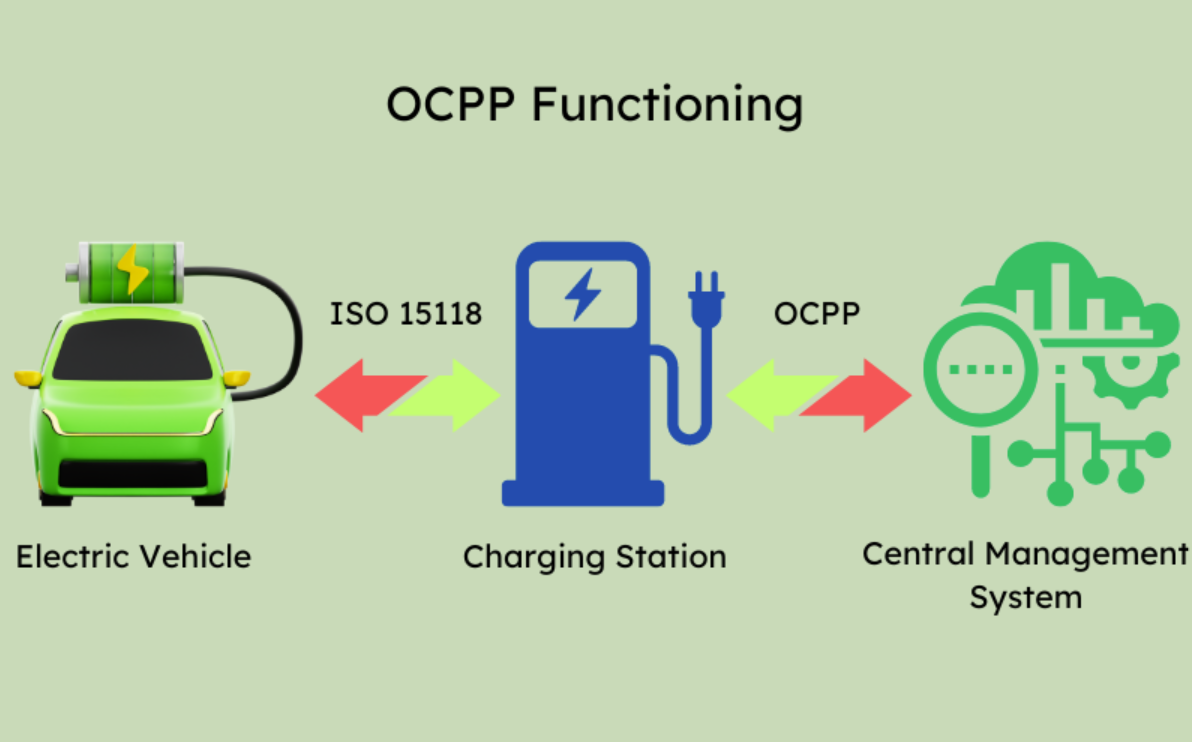
ISO 15118-20 support. Full integration with ISO 15118-20, enabling Plug & Charge authentication and bidirectional power transfer signaling between vehicle and charger — a prerequisite for any serious Vehicle-to-Grid (V2G) deployment.
Bidirectional charging functional block. A dedicated new block that standardizes how Vehicle-to-Home (V2H) and V2G energy flows are managed through OCPP, covering session negotiation, metering, and settlement.
Distributed Energy Resource (DER) control. Chargers are increasingly co-located with solar panels, battery storage, and building energy management systems. The new DER functional block lets a CSMS orchestrate these assets alongside EV charging, turning a charging site into a fully managed microgrid node.
Improved smart charging. Enhanced tariff-based and time-of-use charging profiles give CPOs finer control over load management, enabling better demand response participation and reduced electricity costs — critical for the economics of AI-driven energy management.
Battery swapping support. For the first time, OCPP officially supports battery swap stations for two-wheelers, three-wheelers, and electric vehicles — a segment booming across Asia-Pacific markets.
New authorization and payment options. Prepaid charge card support, ad hoc credit/debit card payments via built-in terminals, and secure dynamic QR codes dramatically improve the consumer experience and align with AFIR's payment accessibility requirements.
Extended transaction handling. Fixed-cost, fixed-energy, and fixed-time transactions are now explicitly supported, along with the ability to resume transactions after a forced charger reboot — a reliability improvement that field operators have long requested.
Impact on CPOs, OEMs, and Charging Networks
The IEC 63584-210 designation triggers a cascade of practical consequences across the value chain:
For Charge Point Operators (CPOs): If you haven't started upgrading to OCPP 2.1, the clock is ticking. Public procurement in the EU and other regulated markets will increasingly require IEC 63584-210 compliance. Existing OCPP 2.0.1 deployments remain supported, but new installations should target 2.1 to avoid costly retrofits. The OCA certification program is already issuing OCPP Product Family Certificates, providing a clear compliance pathway.
For OEMs and hardware manufacturers: Charger firmware must implement the full IEC 63584-210 feature set to qualify for certified interoperability. This includes the new bidirectional charging and DER control blocks — not optional nice-to-haves, but features that regulators and large CPOs will demand. Companies still shipping OCPP 1.6 hardware face growing market exclusion.
For CSMS and software providers: Backend systems need to support the expanded message set, particularly around cybersecurity profiles (Security Profile 3 with TLS 1.3), DER orchestration, and the new payment flows. The transition also demands rigorous OCTT (Open Charge Compliance Test Tool) validation to ensure backward compatibility with OCPP 2.0.1 charge points.
For fleet operators and energy companies: IEC 63584-210 simplifies multi-vendor deployments. A depot with chargers from three different manufacturers, all certified to IEC 63584-210, guarantees protocol-level interoperability — reducing integration costs and enabling competitive hardware procurement. For energy companies exploring V2G revenue models, the bidirectional and DER blocks provide the standardized signaling layer that has been missing.

V2G, DER Control, and the Energy Transition
Perhaps the most transformative aspect of IEC 63584-210 is how it positions EV charging infrastructure as an active participant in the energy transition, not just a consumer of electrons.
The bidirectional charging functional block standardizes the full V2G workflow: from session initiation and energy offer negotiation, through metered bidirectional energy transfer, to settlement and reporting. Before OCPP 2.1, V2G implementations relied on proprietary extensions or out-of-band communication, making cross-vendor deployments nearly impossible. Now, any CSMS implementing IEC 63584-210 can orchestrate V2G sessions across any compliant charger — a game-changer for virtual power plant (VPP) operators and grid aggregators.
The DER control block goes further. A single charging site may combine 50 kW of rooftop solar, a 100 kWh stationary battery, and ten 22 kW AC chargers. With the DER functional block, the CSMS can manage all these assets holistically — curtailing solar export during grid congestion, shifting EV charging to off-peak hours, and dispatching stored energy during demand peaks. This turns every charging location into a potential smart energy hub that can participate in wholesale energy markets and ancillary service programs.
Combined with ISO 15118-20 support for bidirectional power transfer at the vehicle-charger interface, IEC 63584-210 completes the communication stack from grid operator, through CSMS, to charger, to vehicle. This end-to-end standardization is what the industry has been waiting for to scale V2G beyond pilot projects.
OCPP Certification and Compliance Roadmap
The OCA has been building the compliance infrastructure in parallel with the IEC process. Here is the current landscape:
OCPP Certification Program. The OCA certification program validates OCPP implementations through accredited testing laboratories. Certification covers conformance to the specification, security profiles, and interoperability scenarios. In February 2026, OCA issued its first OCPP Product Family Certificates, signaling that the program is fully operational.
OCPP Golden SUT. The OCA has launched a second call for applications for OCPP Golden SUTs (Systems Under Test) — reference implementations that serve as benchmarks for interoperability testing. Becoming a Golden SUT demonstrates industry leadership and provides early access to emerging test specifications.
OCTT (Open Charge Compliance Test Tool). OCA's official test tool is regularly updated to cover new OCPP 2.1 use cases. It remains the primary tool for pre-certification validation and is available to all OCA members.
Timeline recommendation. Organizations planning deployments in 2026–2027 should target IEC 63584-210 (OCPP 2.1) compliance now. Start with a gap analysis against your current implementation, engage an accredited testing laboratory, and budget for certification costs in your next procurement cycle.
What Comes Next: The OCPP & IEC 63584 Roadmap
The IEC 63584 series is not a one-time publication — it is a living framework. Several developments are already in motion:
Regional & Regulatory Requirements Working Group. The OCA's working group is actively addressing region-specific regulatory requirements, ensuring that IEC 63584-210 accommodates local compliance needs without fragmenting the global standard. Monthly sessions are open to members and address topics from European AFIR alignment to Asian market adaptations.
Local Controller Task Group. As charging sites grow in complexity — combining multiple chargers, batteries, and solar arrays — the need for a local site controller increases. This task group is defining how local controllers interact with both chargers and the CSMS within the OCPP framework.
Continued IEC collaboration. The OCA has established liaison membership pathways for IEC experts, ensuring that future OCPP versions benefit from the IEC's broader standards ecosystem, including harmonization with ISO 15118, IEC 61851 (conductive charging systems), and IEC 62196 (plugs, socket-outlets, connectors).
OCPP 1.6 end-of-life planning. While OCPP 1.6 remains widely deployed, it is not part of the IEC 63584 series and will not receive IEC recognition. Organizations still running 1.6 implementations should begin migration planning. The transition path is clear: OCPP 2.0.1 (IEC 63584) offers a stepping stone, and OCPP 2.1 (IEC 63584-210) is the target. All application logic from 2.0.1 is forward-compatible with 2.1.
The transformation of OCPP from an industry consortium protocol to an IEC international standard represents a maturation point for the entire EV charging sector. It signals that electric vehicle charging infrastructure is no longer an emerging technology experiment — it is a regulated, standardized, investment-grade asset class. For those of us working at the intersection of EV charging, energy systems, and smart grid technology, IEC 63584-210 is not just a document reference. It is the foundation we will build on for the next decade.